


Flex Day Offerings
All Fullerton College faculty are required to participate in district-facilitated training. Faculty are to attend the first morning session featuring a keynote speaker presentation. Then, after a break, faculty can attend two breakout sessions covering various topics of interest. A Flex Day program will provide a list of options.
Propose an Activity
Host a Breakout Session
Faculty can apply to lead one or more breakout sessions: there are two 1.5-hour breakout session slots.
Division/Department Activities
In lieu of participating in the scheduled breakout sessions, departments can propose professional learning plans to fulfill the 3 flex hours beyond the 2-hour morning session.
Application and Approval
A call for proposals will go out via email from staffdev@fullcoll.edu with information and a link to fill out a Flex Day Proposal Form.
The Professional Learning Committee will review proposals and notify faculty organizers via email before the end of the semester that their proposals have been approved. Confirmation of proposals may be delayed if the Professional Learning Committee requires clarification.
 Faculty should submit the Mandatory Flex Day Verification Form-Credit Faculty for the current semester to their dean as a record of their participation in Flex Day activities.
Flex Day Program (Fall 2026)
Fall 2026 Flex Day Keynote Presentation
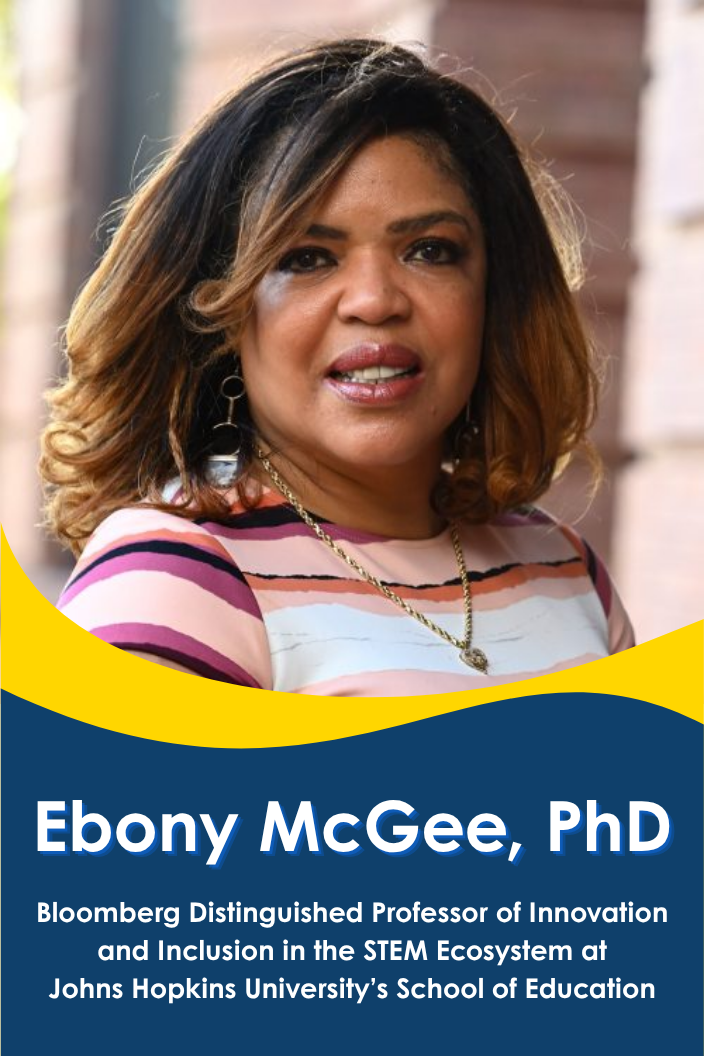
Breaking the Cycle of Racial Isolation: Building Emancipatory Networks and Equity Ethics at Fullerton College by Ebony Omotola McGee, Ph.D.
Abstract
Racial isolation is not an accidental byproduct of STEM education — it is a structural feature of systems that privilege whiteness while marginalizing Black, Latinx, and Indigenous students and faculty, producing racial battle fatigue, weathering, and the misdiagnosis of systemic failure as individual “impostor syndrome.” At Fullerton College, as at many community colleges, these barriers are compounded by basic needs insecurity: two out of three California community college students experience at least one (2023–2024 California Community Colleges Report on Basic Needs). Grit and resilience narratives pathologize rational responses to hostile environments; the answer is not making students and faculty more resilient, but dismantling the conditions that demand it.
This keynote moves beyond critique to practical, faculty-driven guidance — even amid budget constraints — focused on two actionable areas: cultivating relational networks that replace isolation with collective liberation, and practicing Equity Ethics, the shift from belief in justice-oriented work to the behaviors that dismantle barriers. Dr. McGee centers what’s possible now: empowering faculty, especially BIPOC faculty and allies, to act as architects of a more just STEM future — one classroom, one committee, one relational network at a time.
Key themes:
- Racial isolation as a structural — not individual — feature of STEM education
- Basic needs insecurity and the community college’s dual mandate
- Rejecting grit and resilience narratives that pathologize rational responses to hostile environments
- Relational networks: classroom counterspaces, affinity groups, relational accountability
- Equity Ethics: moving from equity ethos to equity action
Keynote Speaker
Flex Day Schedule
9:00 AM – 11:00 AM
11:15 AM – 12:45 PM
12:45 PM – 1:30 PM
1:30 PM – 3:00 PM
Keynote
Breakout Session #1
Lunch Break
Breakout Session #2